



On this page0%
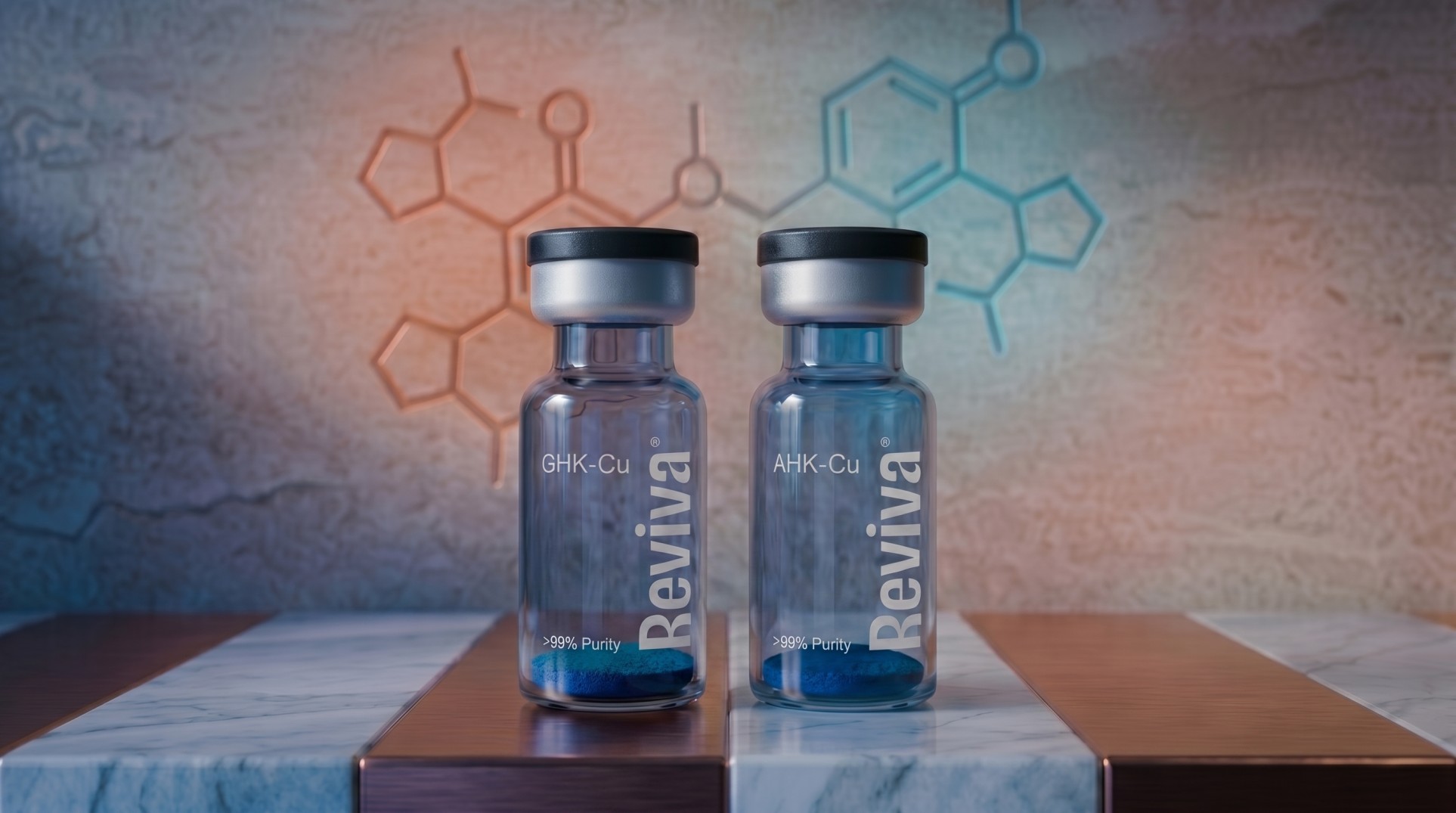
GHK-Cu and AHK-Cu are often mentioned in the same breath: both are small copper-binding peptides studied in skin and hair research, both are sold as blue-tinted copper complexes, and both trace back to the same line of investigation into copper delivery. But treating them as interchangeable misreads the literature. Here is how they actually differ.
For laboratory and research use only. The summaries below describe published research models, not outcomes, recommendations, or dosing guidance.
Start with the structure
Both molecules are tripeptides — three amino acids — bound to a copper(II) ion. The difference is one residue:
- GHK-Cu is glycyl-L-histidyl-L-lysine plus copper. The histidine residue is central to how it coordinates the copper ion.
- AHK-Cu is alanyl-L-histidyl-L-lysine plus copper. The first residue is alanine instead of glycine.
That single substitution looks trivial on paper, but in peptide chemistry the identity of each residue changes the molecule's shape, charge distribution, and how tightly and in what geometry it holds copper. The shared histidine–lysine tail is why both are copper carriers at all; the differing first residue is why they are studied as distinct compounds. You can review each one's background in the Peptide Pedia entry for GHK-Cu and for AHK-Cu.
Why copper is the point
Neither peptide is interesting without the copper. The copper(II) ion is the functional payload, and the peptide is essentially a delivery and presentation vehicle that holds the ion in a specific coordination state. Copper is a cofactor in a range of enzymatic processes studied in connective-tissue and follicular research, which is why copper tripeptides became a research target in the first place.
The practical implication: storage and handling that protects the copper coordination matters as much as protecting the peptide backbone. Oxidation state and chelation are part of what you are preserving.
Where the research emphasis diverges
This is where the two part ways in the literature rather than in the test tube:
- GHK-Cu has the larger and older body of research. It has been studied across skin-remodeling, wound-healing, and broader regenerative contexts, and it appears frequently in work on extracellular-matrix and gene-expression effects. It is the more "general purpose" copper peptide in the literature.
- AHK-Cu shows up most often in hair-focused research — work around the follicle, vascularization of the follicular environment, and hair-shaft parameters. Its research footprint is narrower and more specialized.
So while their structures are nearly identical, researchers tend to reach for them in different experimental contexts. That is the most useful way to think about "which one" — not better or worse, but pointed at different questions.
Handling: effectively the same discipline
Because they are chemically close, their handling profiles are similar. Both are lyophilized powders reconstituted with a sterile diluent, both should be kept cold and dark once in solution, and both are sensitive to the same degradation pathways — with the added consideration of protecting the copper complex. The general approach in our reconstitution guide applies to both, and Peptide Reconstitution & Storage covers the underlying degradation chemistry in more depth.
Quick reference
| GHK-Cu | AHK-Cu | |
|---|---|---|
| First residue | Glycine | Alanine |
| Shared motif | Histidine–Lysine + Cu²⁺ | Histidine–Lysine + Cu²⁺ |
| Research emphasis | Broad skin / matrix / repair | Hair / follicle focused |
| Literature volume | Larger, older | Narrower, specialized |
Key takeaways
Key Takeaways
- GHK-Cu and AHK-Cu are both copper-binding tripeptides that share a histidine–lysine motif and a copper(II) ion.
- They differ by a single residue — glycine in GHK-Cu, alanine in AHK-Cu — which is enough to make them distinct compounds.
- GHK-Cu has the larger, older literature (skin, matrix, repair); AHK-Cu's research footprint is narrower and more hair- and follicle-focused.
- The copper is the functional payload, so handling that protects the copper complex matters alongside protecting the peptide backbone.
- They are best understood as separate research tools for related questions, not as substitutes for one another.
Bottom line
GHK-Cu and AHK-Cu are siblings, not twins. One amino-acid swap keeps the copper-carrying machinery intact while shifting where each compound shows up in research. If your work is broadly skin- or matrix-oriented, GHK-Cu is the more studied starting point; if it is specifically follicular, AHK-Cu is the compound the hair literature actually uses. Match the molecule to the question rather than assuming they substitute for one another.