



On this page0%
In analytical testing, few terms appear more frequently than purity and identity. They sit side by side on Certificates of Analysis, surface throughout quality documentation, and are routinely cited as indicators of product quality. Yet despite their importance, the two are frequently conflated.
The most common assumption is that a highly pure sample must also be the correct compound. In reality, purity and identity answer two entirely different questions — and understanding the distinction is essential for interpreting analytical data, evaluating a Certificate of Analysis, and appreciating why modern testing leans on more than one instrument.
Two Questions, Not One
At a glance, purity and identity appear closely related. Both contribute to quality assessment, both are verified through laboratory testing, and both appear on analytical reports. But each addresses a separate question.
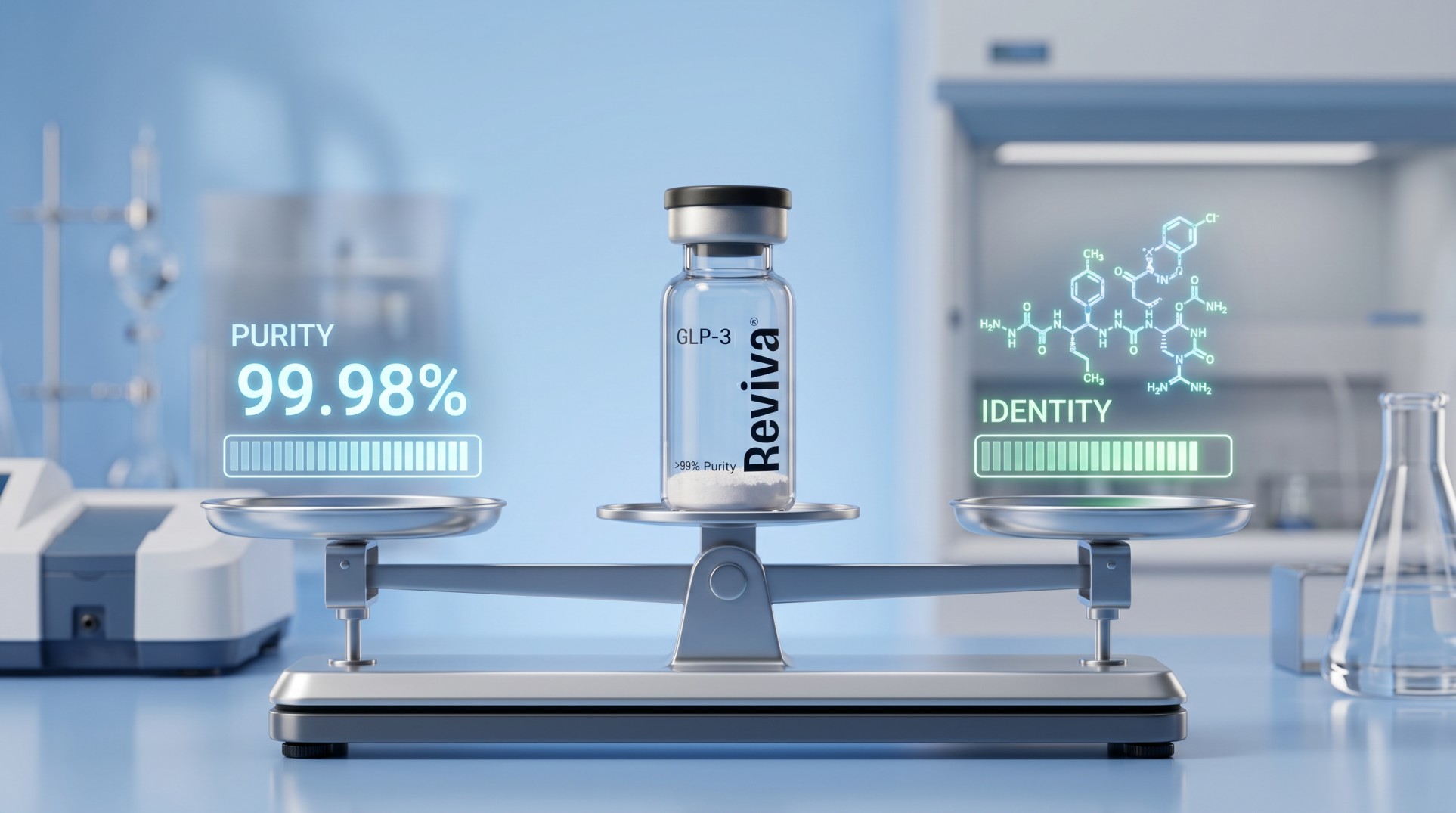
Purity asks: how much of the sample consists of the intended material?
Identity asks: is the sample actually the material it is claimed to be?
These may sound similar, but they measure fundamentally different characteristics. A sample can exhibit high purity while still requiring identity confirmation. Equally, a sample can have a confirmed identity while failing to meet a purity specification. Sound quality assessment requires both answers.
- HPLCHow pure is it?Is the sample homogeneous?
- Mass SpectrometryWhat is it?Is it the correct compound?
- COA TraceabilityDoes it match the batch?Is the result traceable?
Purity and identity are different questions answered by different methods — meaningful verification needs both.
What Does Purity Measure?
Purity refers to the proportion of a sample that consists of the intended substance relative to other detectable components. Analytical methods evaluate it by examining the presence and quantity of impurities, synthesis byproducts, degradation products, and other unwanted material.
A sample reported as ≥99% pure indicates that the overwhelming majority of detectable material corresponds to the primary compound being evaluated. That matters because purity influences consistency, reproducibility, and overall quality.
But purity alone does not establish what the compound is. It only describes how much of the measured material appears to be present relative to detectable impurities.
What Does Identity Measure?
Identity testing focuses on confirmation. Its purpose is to verify that a sample corresponds to the compound it is claimed to be. Rather than asking how much material is present, identity testing asks whether the material itself is correct.
The distinction is best shown with a simple scenario. Imagine receiving a container labeled as Compound A. Analytical testing reveals the material is 99% pure. At first glance, that appears reassuring — but what if the material is actually Compound B? The sample may still be highly pure. It simply isn't the substance it was intended to be. Closely related molecules make this concrete: GHK-Cu and AHK-Cu differ by a single amino acid, so a clean purity result says nothing about which of the two is actually in the vial.
A purity percentage tells you how clean a sample is. It does not, by itself, tell you what the sample is.
Identity testing exists to address precisely this question. The objective is confirmation rather than quantification.
Why Purity Alone Is Not Enough
One of the most common misconceptions in analytical testing is the belief that purity automatically confirms identity. In practice, purity measurement and identity confirmation often require different analytical approaches. A laboratory may determine that a sample contains very little contamination while still needing additional methods to verify the compound itself.
This is why quality-focused testing programs rarely rely on a single measurement:
- Purity data provides one piece of information.
- Identity data provides another.
- Taken together, they create a far more complete picture of quality.
Without identity confirmation, purity results may be incomplete. Without purity assessment, identity confirmation lacks context. Both are necessary.
How Laboratories Assess Purity
Several analytical techniques contribute to purity evaluation. One of the most widely recognized is High-Performance Liquid Chromatography (HPLC). HPLC separates the components within a sample and lets analysts evaluate the relative proportions of detectable substances, which makes it particularly well suited to assessing purity.
When researchers review a chromatogram, they are usually examining information directly related to purity. The technique helps answer the question: how much of the sample appears to consist of the primary compound?
Valuable as it is, HPLC is generally not designed to answer every question about molecular identity. Its primary strength lies elsewhere.
How Laboratories Assess Identity
Identity confirmation relies on methods capable of examining molecular characteristics more directly. Mass spectrometry is the standard example. Rather than focusing on relative proportions, it helps determine whether a sample possesses the expected molecular mass and attributes, allowing a laboratory to compare observed results against known reference values.
Again, the objective is confirmation. Researchers are seeking evidence that the material corresponds to the compound being claimed — answering the question: is this actually what it is supposed to be?
Why Multiple Testing Methods Are Often Used
No single analytical technique provides every answer. Each method has strengths, limitations, and specific applications, which is why laboratories frequently employ several when evaluating quality. One method may speak to purity, another may support identity confirmation, and additional tests may examine moisture content, residual solvents, contaminants, or degradation products.
Viewed together, these tools provide a more complete assessment than any individual test could offer on its own. Quality is rarely determined by a single number — it is established through multiple forms of evidence working in concert. The same principle is why independent, third-party testing carries more weight than a single in-house figure.
A Related Distinction: Purity vs Content
Identity is not the only thing a high purity figure can quietly omit. Content — how much actual peptide is present in a vial versus accompanying water, salts, and counter-ions — is a separate measurement again. A sample can be highly pure by HPLC and correctly identified by mass spectrometry, yet still contain less net peptide by mass than the label implies.
Two different denominators: purity is peptide-relative; peptide content is mass-relative. Both numbers can be correct at once.
The takeaway is consistent: each metric answers its own question, and a confident assessment depends on reading them together rather than letting one stand in for the rest.
Understanding Certificates of Analysis
A Certificate of Analysis often carries information relating to both purity and identity, and researchers should recognize that these measurements serve different purposes. A purity result indicates the relative cleanliness of a sample; an identity result supports confirmation of the material itself. Neither replaces the other — they complement one another, and when interpreted correctly both contribute to a more informed understanding of quality.
This is one reason quality-focused programs emphasize comprehensive analytical evaluation rather than reliance on a single metric. You can see how this plays out on a real document — for example the COA referenced from a product page such as GHK-Cu or GLP-1 — where purity and identity appear as distinct, separately sourced results.
Looking Beyond Percentages
Purity percentages are easy to understand. They are concise, measurable, and frequently highlighted in specifications. But quality cannot be reduced to a single number. A reported purity value tells only part of the story; understanding identity, analytical methods, testing limitations, and verification procedures provides a far more complete perspective.
Researchers benefit most when they treat analytical data as a set of interconnected findings rather than isolated measurements. The strongest assessments combine multiple sources of evidence into a coherent picture.
Key Takeaways
- Purity and identity are closely related but fundamentally different: purity measures how much of a sample is the intended material; identity confirms whether the material is what it is claimed to be.
- A highly pure sample is not automatically a confirmed sample — and a confirmed sample is not automatically a pure one.
- Purity is typically assessed by HPLC; identity is typically confirmed by mass spectrometry. The two answer different questions.
- Content (net peptide by mass) is a third, separate metric that a purity figure does not capture.
- Modern analytical testing relies on multiple methods because no single technique answers every question — and a credible COA reports them together.