



On this page0%
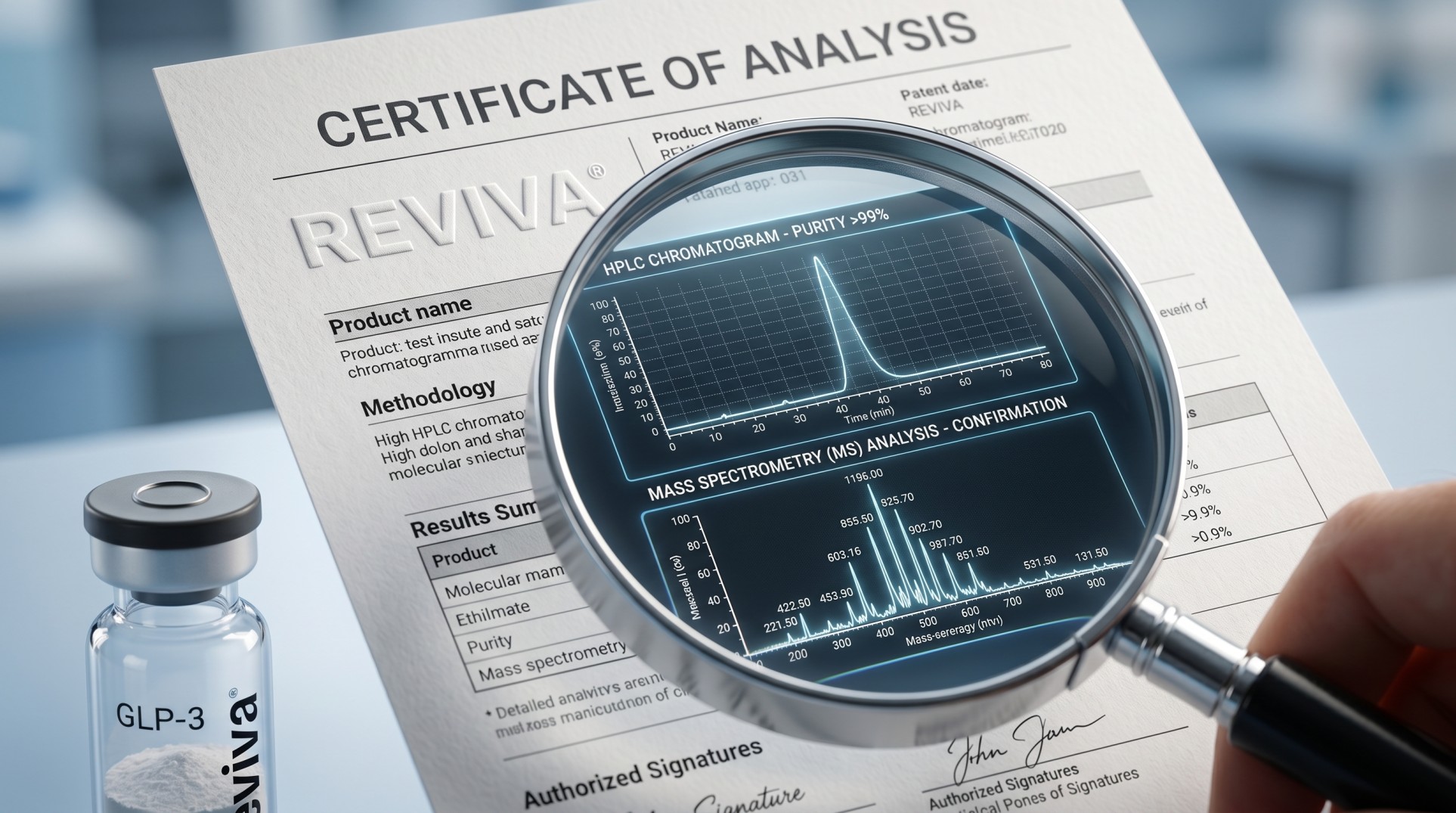
Two numbers carry most of the weight on a peptide Certificate of Analysis: a purity percentage and a confirmed mass. They come from two completely different instruments answering two completely different questions. Confusing them — or accepting one in place of the other — is one of the easiest ways to misread a COA.
For laboratory and research use only. Nothing below is medical, clinical, or dosing guidance.
The two questions
- HPLC (high-performance liquid chromatography) answers: how much of what is in this vial is the target compound? It is a purity measurement.
- Mass spectrometry (MS) answers: is the target compound actually the molecule it claims to be? It is an identity measurement.
A sample can be 99% pure and still be the wrong peptide. It can also be the correct peptide but only 80% pure. Purity and identity are independent, which is exactly why both instruments appear on a complete COA.
How HPLC measures purity
HPLC pushes the dissolved sample through a packed column under high pressure. Different molecules travel through the column at different speeds depending on how strongly they interact with the packing material, so they exit — elute — at different times. A detector records each component as a peak, and the area under each peak is proportional to how much of that component is present.
A pure peptide shows as one dominant, sharp, symmetric peak with very little else. The reported purity figure is essentially that main peak's area as a percentage of total peak area. Small extra peaks are impurities, and a credible report doesn't hide them.
How mass spectrometry confirms identity
Mass spectrometry ionizes the molecule and measures its mass-to-charge ratio with high precision. Because every peptide has a known theoretical mass derived directly from its amino-acid sequence, MS lets you compare the measured mass against the expected one. A match within a tight tolerance is strong evidence that the molecule is what the label says.
This is the check HPLC cannot make. If a synthesis produced a closely related but incorrect sequence — a missing residue, a substitution — HPLC might still show a clean single peak, but the mass would be wrong. MS catches that.
Why a COA needs both
Put the two together and the logic closes:
- MS confirms the main component is the intended peptide (correct identity).
- HPLC confirms that intended peptide makes up the overwhelming majority of the sample (high purity).
Either one alone leaves a gap. This is the same reasoning behind what a purity percentage actually means: the number is only trustworthy once you know it was measured on the right molecule. A COA that reports HPLC purity but no mass confirmation — or vice versa — is only telling you half the story.
Key Takeaways
- HPLC measures purity (how much of the sample is the target); mass spectrometry confirms identity (whether it is the right molecule).
- Purity and identity are independent — a sample can be highly pure and still be the wrong peptide.
- A credible Certificate of Analysis reports both, because each instrument covers the other's blind spot.
Once you can read both halves of the report, the rest of a COA — batch identity, endotoxin, appearance — becomes straightforward; each sits among the other analytical methods a lab runs. Compounds like GHK-Cu and BPC-157 should each arrive with this dual verification, and you can review the underlying chemistry of GHK-Cu in its Peptide Pedia entry.