



On this page0%
In any field where quality matters, trust is built through verification rather than promises — and research compounds are no exception. Every supplier says their peptides are pure. The question that actually matters is who checked. A purity number a vendor generated on its own equipment and a purity number an unaffiliated laboratory generated are not the same kind of evidence, even if they print the identical figure. Third-party testing exists to close that gap.
The phrase appears constantly across the research compound industry, and most researchers recognize it as a positive signal. Far fewer can say what it actually involves, what it can verify, and where its limits begin. This article walks through all three.
For laboratory and research use only. Nothing below is medical, clinical, or dosing guidance.
What "third-party" actually means
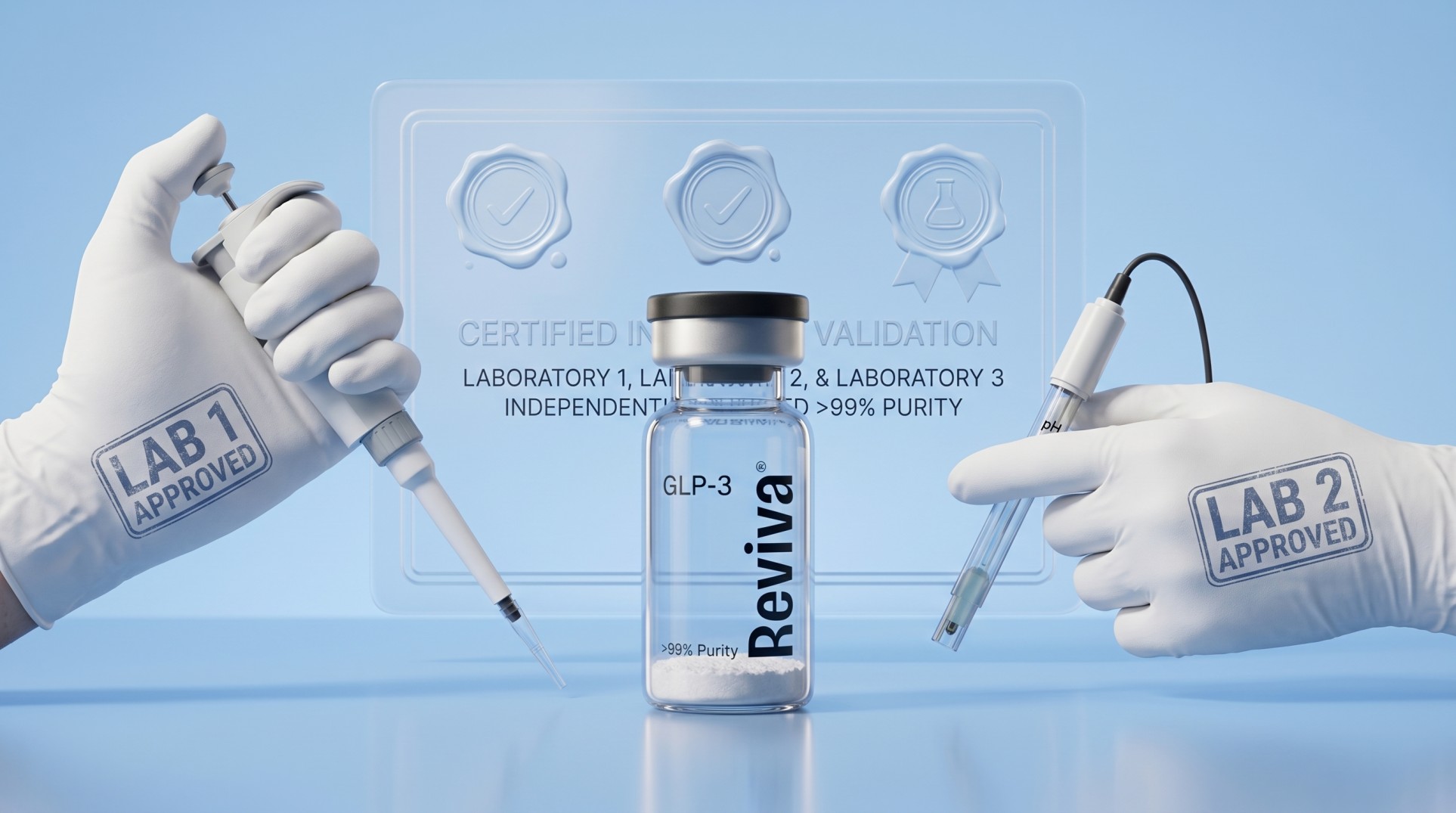
The three parties are: the buyer (first party), the seller (second party), and an independent laboratory with no financial stake in the result (third party). Third-party testing means that last group — not the seller — ran the analysis. Rather than relying solely on internal quality control, a sample is submitted to an external lab that analyses it with established methods and instrumentation and reports what it measures.
The distinction matters because the seller has an obvious incentive for the number to look good. An independent lab is paid to measure, not to please — it has no reason to round a 97% up to a "≥99%." Independence is the entire value: the same HPLC and mass-spec instruments in a captive in-house lab produce a weaker claim simply because of who controls the outcome.
Why independence matters
Picture a manufacturer claiming a product exceeds 99% purity. The claim may be entirely accurate. It may also rest on outdated testing, an incomplete analysis, or inconsistent QC. Without independent verification, the researcher is left with a single source of information and no way to weigh it.
Third-party testing introduces a second layer of accountability. When an external laboratory reaches conclusions that line up with the manufacturer's internal specifications, confidence in the reported data rises. The point is not to assume dishonesty — it is to reduce the room for bias, error, or oversight. The same logic governs pharmaceutical manufacturing, food production, and clinical research: verification simply carries more weight when it comes from a source with nothing to gain.
What third-party testing can verify
What a report can tell you depends entirely on the methods used — different tests answer different questions, and no single test paints the whole picture.
- HPLCHow pure is it?Is the sample homogeneous?
- Mass SpectrometryWhat is it?Is it the correct compound?
- COA TraceabilityDoes it match the batch?Is the result traceable?
Purity and identity are different questions answered by different methods — meaningful verification needs both.
- High-Performance Liquid Chromatography (HPLC) is the workhorse for purity — what fraction of the sample is the target compound versus everything else.
- Mass Spectrometry (MS) helps confirm identity — whether the molecule is actually the one named on the label.
- Additional methods can probe impurities, degradation products, residual solvents, or moisture content.
Purity and identity are separate questions, which is why a credible program pairs the two rather than leaning on one. Understanding what a given test measures is usually more important than simply knowing that "a test was performed" — the same reason ≥99% only means something once you know how it was measured.
Third-party testing and the COA
The most visible output of independent testing is the Certificate of Analysis (COA) — a technical record that gives researchers access to measurable quality data rather than a marketing adjective. Depending on the lab and protocol, a COA may include purity results, identity confirmation, batch information, test dates, the analytical methods used, chromatograms, and reference standards.
A meaningful third-party COA is tied to a specific batch, not the product line in general. A single dusty certificate from two years ago covering "the product" is not the same as a current, batch-matched report. This ties directly into reading a COA: the batch and date fields are what link the paper to the vial in your hand. Not all COAs carry the same level of detail, and not all testing programs are equally thorough — so knowing how to read one is as important as having one.
How to confirm independence
A few practical checks separate real third-party verification from marketing language:
- Named laboratory. The report should identify the testing lab — a name and contact, not just an unattributed logo.
- Batch and date match. The COA's batch number should match the label on the vial, with a recent test date.
- Raw method data. Real reports include the actual HPLC chromatogram and mass-spec trace, not just a summary number.
- Verifiable on request. A credible supplier can connect a batch back to its independent report when asked.
What third-party testing cannot do
Independent testing is valuable, but it is not a guarantee of perfection, and treating a single report as proof that "all uncertainty is gone" is a mistake. Every result is only as meaningful as the sample submitted, the methods chosen, the lab's procedures, and the scope of what was actually tested.
The role of transparency
The deeper value of third-party testing is transparency. When analytical data is available for review, researchers can evaluate a claim on evidence instead of assumption — specifications can be examined, methods understood, and results judged on their own merits. That is exactly why independent testing has become one of the most widely recognised markers of a quality-focused supplier: it moves the conversation away from marketing language and toward measurable data.
Key Takeaways
- "Third-party" means an independent lab with no stake in the result ran the test — not the seller.
- Independence removes the conflict of interest, which is what gives a purity claim its weight.
- Different methods answer different questions: HPLC for purity, MS for identity — no single test is complete.
- A real third-party COA is batch-specific, recent, names the lab, and includes raw method data.
- Testing has limits; it is strongest as part of a quality system, and its greatest value is the transparency it creates.
Independent verification is why a purity figure becomes evidence rather than a marketing adjective. Compounds like BPC-157 and TB-500 should each trace back to a batch-matched, independent report, and you can review BPC-157's background in its Peptide Pedia entry.