



On this page0%
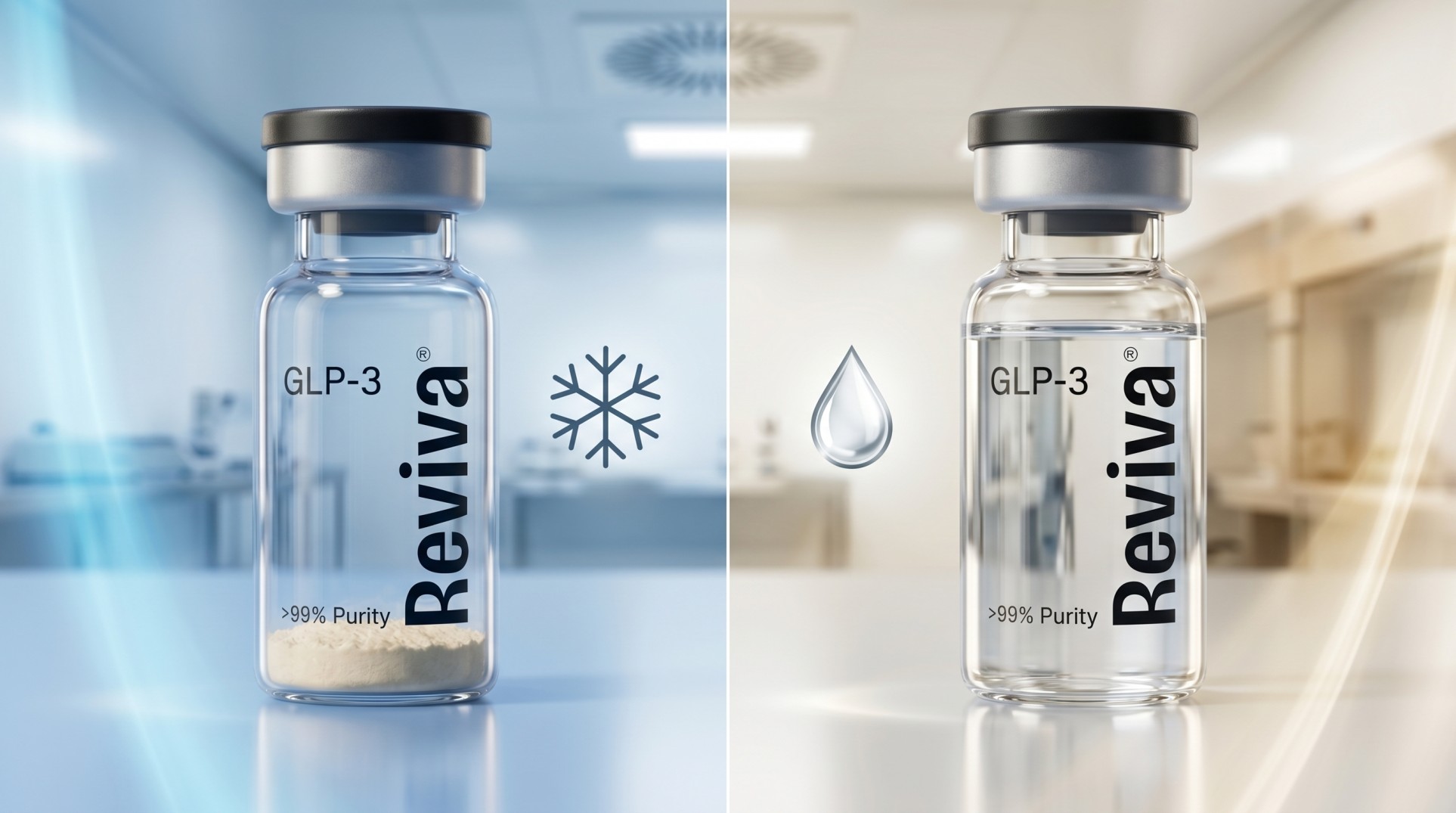
Many research compounds begin their journey in a lyophilized form. Researchers encounter the term constantly — on product specifications, Certificates of Analysis, and storage recommendations — yet the distinction between lyophilized and reconstituted material is one of the most frequently misunderstood points in practical handling.
At first glance the difference looks trivial. One is a dry powder; the other is a liquid solution. In reality, the transition between those two states carries real implications for storage, handling, stability, transport, and long-term quality management. Understanding how the two forms differ helps researchers make better decisions about preparation, storage, and laboratory workflow.
What "lyophilized" means
Lyophilization — often called freeze-drying — is a preservation process designed to remove water from a material while maintaining its structural integrity. The solution is frozen, then held under carefully controlled low pressure that lets the ice transition directly from solid to vapor without passing through a liquid phase. That sublimation step is what leaves behind a dry, porous solid often referred to as a lyophilized cake.
The process is widespread because many biological and peptide-based materials are far more stable in a dry state than in solution. Removing water dramatically slows many of the chemical reactions that drive degradation, which is why lyophilization has become a standard preservation strategy across the pharmaceutical, biotechnology, and research industries.
What "reconstituted" means
Reconstitution is the reverse step: adding a suitable diluent to a lyophilized material to return it to a usable liquid form. Depending on the application, common diluents include:
- Sterile water
- Bacteriostatic water
- Buffered solutions
- Other laboratory-grade preparation media
For any vial that will be accessed more than once, bacteriostatic water — water with 0.9% benzyl alcohol — is the usual choice, because it suppresses microbial growth across repeated draws. Our reconstitution guide walks through the mechanics step by step.
Once a compound is reconstituted, it exists in an entirely different physical environment than it did as a dry powder, and that change introduces new considerations for stability, handling, and storage.
Why stability changes after reconstitution
The single most important difference between the two states is stability.
Water is central to many chemical and biological processes. It is necessary to create a usable solution, but it also enables the very reactions that contribute to degradation over time. In a lyophilized state, those pathways proceed far more slowly; after reconstitution, the same processes can accelerate considerably.
How much stability changes depends on several interacting factors:
- Compound characteristics and sequence
- Storage temperature
- Solution concentration
- pH conditions
- Diluent selection
This is also why the underlying degradation chemistry matters. When a peptide in solution "goes bad," specific reactions are at work — hydrolysis of the backbone, oxidation of vulnerable residues, aggregation into inactive clumps, and adsorption onto container surfaces at low concentrations. Our reconstitution & storage deep dive covers those pathways in detail.
Storage considerations
Lyophilized materials are generally easier to store and transport because they contain little or no free water. That absence improves long-term stability and reduces sensitivity to environmental change.
Once reconstituted, additional precautions are usually required. Depending on the material and intended use, researchers may need to weigh:
- Refrigeration requirements
- Light exposure
- Temperature fluctuations
- Handling and access frequency
- Total storage duration
These details vary by compound, but the governing principle is consistent: reconstituted solutions require more careful management than their lyophilized counterparts. Our storage & handling guide translates that principle into a practical cold-chain routine.
Why lyophilization is so widely used
The popularity of freeze-drying comes from its ability to improve preservation while keeping a material usable. For many compounds it offers:
- Improved storage stability
- Reduced degradation risk
- Simplified transportation
- Extended shelf-life potential
- Greater flexibility in when preparation happens
Rather than storing a compound permanently in solution, researchers can keep it dry until it is actually needed — minimizing its exposure to the conditions that drive long-term degradation.
Common misconceptions
A frequent misconception is that reconstitution somehow improves a material. It does not. Reconstitution simply changes the physical form; the objective is usability, not enhancement.
A second misconception is that all compounds behave the same way once reconstituted. They do not. Different materials exhibit very different stability characteristics depending on their structure and formulation — some remain stable for extended periods under appropriate conditions, while others call for more immediate use after preparation. Recognizing that variability is a core part of responsible handling, and it ties directly to verifying what you actually have via a Certificate of Analysis.
Choosing when to reconstitute
Because solutions carry extra storage demands, many researchers deliberately delay reconstitution until the material is expected to be used. That keeps the compound in its more stable lyophilized state for as long as practical.
The decision ultimately depends on workflow requirements, available storage conditions, and the characteristics of the specific material — but the underlying logic stays simple: a lyophilized material and a reconstituted solution may share a compound without sharing a stability profile. Sensitive peptides such as BPC-157 reward this kind of just-in-time discipline.
Looking beyond physical form
The difference between lyophilized and reconstituted material extends well beyond appearance. The transition from powder to solution changes how the material interacts with its environment — water, temperature, pH, storage conditions, and handling practices all become more consequential the moment reconstitution occurs.
Understanding that distinction helps researchers interpret storage guidance more effectively and appreciate why preparation procedures so often arrive with specific handling recommendations. The science of stability begins long before a compound ever enters solution.
Key Takeaways
- Lyophilized compounds have been freeze-dried to remove water and improve preservation, leaving a dry, porous cake.
- Reconstituted compounds are created by adding a suitable diluent to that cake, returning it to a usable liquid form.
- Both forms can contain the same underlying compound while differing sharply in stability, storage requirements, and handling.
- Reconstituted solutions are on a degradation clock; lyophilized material is effectively paused — which is why guidance differs before and after.
- Understanding the distinction is essential for interpreting storage recommendations, maintaining quality, and supporting effective laboratory workflows.